

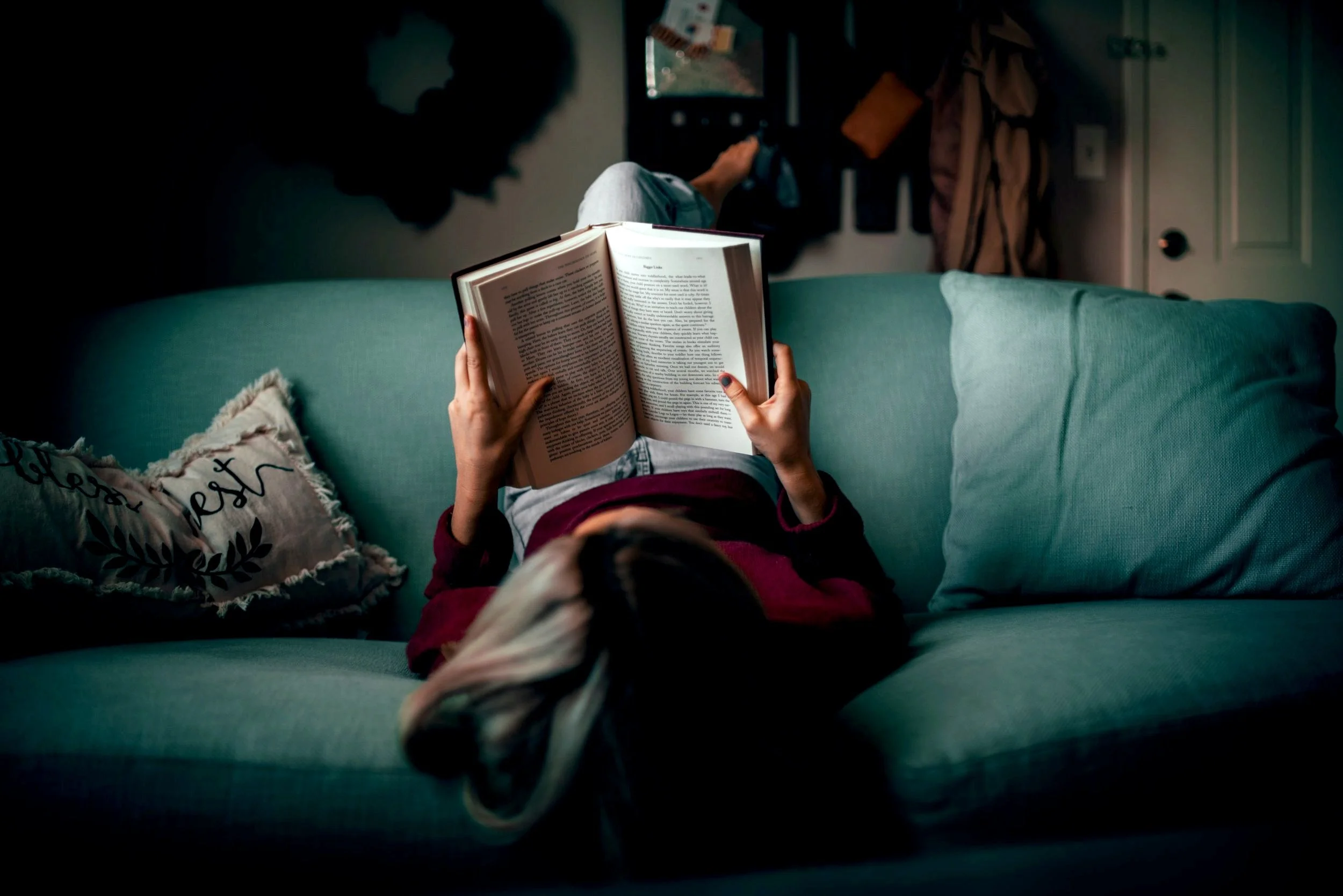
Photo by Matias North on Unsplash
In short: Reading a little every day is one of the simplest ways to look after yourself. It gives your mind a rest from screens and worries, keeps your brain active, widens the way you see other people, and makes a calm end to the day. You don’t need hours: ten minutes with a book you enjoy, at the same moment each day, is enough to feel the difference.
It’s the end of the day. The kitchen is tidy, you sit down at last, and your hand goes to your phone before you’ve even thought about it. Half an hour later you’ve seen a great many things and you can’t remember one of them. You don’t feel rested. If anything, your head is busier than before.
Now picture the same half hour with a book. One story, one voice, one thing to follow. Your shoulders come down, your breathing slows, and when you close the book you feel as if you’ve been somewhere. That’s what I’d love you to have more of, and it’s why I think reading deserves a place among your daily habits.
Why does reading relax you?
Life can be stressful, and most of us spend a large part of the day switching between messages, tasks and screens. Reading asks for the opposite. You do one thing, quietly, at your own speed. Nothing pings, nothing moves, nobody needs an answer.
A good book also takes you out of your own head. For a while you’re in another place, with other people’s problems, and your own can wait. When you come back to them, they often look a little smaller. That’s why a few pages after a long day can help you unwind in a way that an evening of scrolling never does.
And you can do it anywhere: on the train, in a waiting room, in the garden, in bed. If your days feel overloaded, reading fits well alongside the ideas in my article on taking a break from your screens.
What does reading do for your brain?
When you read, your brain works in ways it doesn’t in the rest of the day. You follow a thread, you remember who is who, you picture places you’ve never seen, you link what you’re reading to what you already know. It’s gentle exercise for your mind, and like any exercise it keeps you sharp and alert as you get older.
Reading trains your memory too. Every chapter asks you to hold on to what came before. And it trains your attention, because you stay with one thing instead of jumping between ten. That calmer, steadier focus tends to follow you into the rest of your day, at work, in conversations, in your hobbies. If you’d like more ways to look after your mind, have a look at how to protect your mental energy and at these short coordination exercises for your brain.
How can reading improve your life?
Beyond rest and a livelier mind, a daily reading habit brings quieter gifts that add up over the months.
1. You learn something every day
Books give you ideas, facts and other people’s experience, ready to use. A chapter on sleep, on food, on how habits form: any of them might give you the one sentence that helps you decide something in your own life.
2. You concentrate better
Staying with a book is practice in staying with anything. Many people find that they work more calmly and finish things more easily once reading is part of their day.
3. You feel brighter
A story that makes you laugh, a book that gives you hope, a page that puts words to something you’ve felt for years: reading lifts your mood in a simple and reliable way.
4. You make calmer decisions
Reading slows you down and gets you used to looking at a question from several sides. That habit of pausing and thinking helps when you have a choice to make, large or small.
5. You sleep more easily
A paper book in the last half hour of the evening tells your body that the day is over. It’s one of the simplest parts of an evening routine that helps you wind down, and much kinder to your sleep than a bright screen.
6. You understand other people better
A book lets you see the world through someone else’s eyes: another age, another country, another kind of life. You become more patient and more understanding, and that helps in every relationship, at home and at work.
7. You always have something to talk about
“What are you reading at the moment?” is a lovely way into a conversation. If you’re shy or reserved, a book gives you a comfortable subject, and sharing books is a simple way to stay close to friends.
How do you make reading a daily habit?
Reading every day gives your day a small, steady structure, and once it’s a habit it tends to stay for life. The secret is to make it easy.
Choose your moment. With your first cup of tea, during lunch, or in bed before you turn off the light. Attach it to something you already do, and it becomes part of your morning or evening routine without any effort.
Start small. One or two chapters, or ten minutes. A short read you really do is worth more than a long one you keep putting off.
Keep the book where you’ll see it. On your pillow, next to the kettle, in your bag. Out of sight really is out of mind.
Put your phone somewhere else. In another room if you can. It’s very hard to read with a phone within reach.
Read what you enjoy. You don’t have to finish a book that bores you. Put it down and pick up another one.
Share it. Swap books with a friend, or tell someone about the one you’ve just finished.
I made a short video about this, you can watch it below.
Which books could you start with?
If you’re looking for books that can help you feel better and think differently about your life, here is a list to begin with:
“The Power of Now” by Eckhart Tolle
“The Happiness Project” by Gretchen Rubin
“The Subtle Art of Not Giving a F*ck” by Mark Manson
“The Alchemist” by Paulo Coelho
“The Four Agreements” by Don Miguel Ruiz
“The Miracle Morning” by Hal Elrod
“The 7 Habits of Highly Effective People” by Stephen Covey
“Be Your Future Self Now” by Benjamin Hardy
“Daring Greatly” by Brené Brown
“You Are a Badass” by Jen Sincero
“Longpath: Becoming the Great Ancestors Our Future Needs” by Ari Wallach
Pick the one whose title speaks to you today, and read a chapter or two each day. Your library or a second-hand bookshop will very likely have several of them. And if you enjoy book ideas, I wrote about another book in four simple questions to overcome stress.
Do you have a book you’d recommend? Share it in the comments below.
Frequently asked questions
How long should I read each day?
Start with ten minutes, or even five pages. What counts is that you read most days, at a moment that already exists in your day. Once the habit is there, you will often find yourself reading longer without planning to.
Does it matter what I read?
Much less than you might think. A novel rests your mind and lets you live inside another life for a while. A book about health, habits or mindset gives you ideas to try. Read what you look forward to picking up, because that is the book you will finish.
Is reading on a screen or listening to an audiobook just as good?
A paper book is the easiest way to get a real break from screens, and it is the kindest choice before sleep. An e-reader without notifications works well too. Audiobooks are lovely for walks and for housework. Choose what fits your life.
I fall asleep after two pages. What can I do?
If it happens in bed, take it as a sign that reading is helping you wind down. If you would like to get further in your book, move your reading to an earlier moment: with your morning coffee, at lunch, or in an armchair before you go up to bed.
I cannot concentrate on a book any more. Is that normal?
It is very common when you are tired, stressed or used to scrolling. Concentration comes back with practice. Choose an easy, enjoyable book, put your phone in another room and begin with a few pages at a time.
Would you like some help?
Making room for calm, daily habits such as reading is one of the things we work on in my group programmes in nutrition and health, such as Six Tuesdays in Montignac. If you’d like to hear when the next group opens, write to me at hello@catherinepolet.coach.
Would you rather work one to one? I also coach online. Book a free 20-minute call, and we’ll look together at where a quiet half hour could fit into your days.
About Catherine
I’m Catherine Polet, a holistic nutrition health coach, yoga and autogenic training teacher for more than 30 years, author and speaker. I help people find a way of eating and living that suits their own body, online in English, French, Spanish and German, and in person in Southwest France.

