

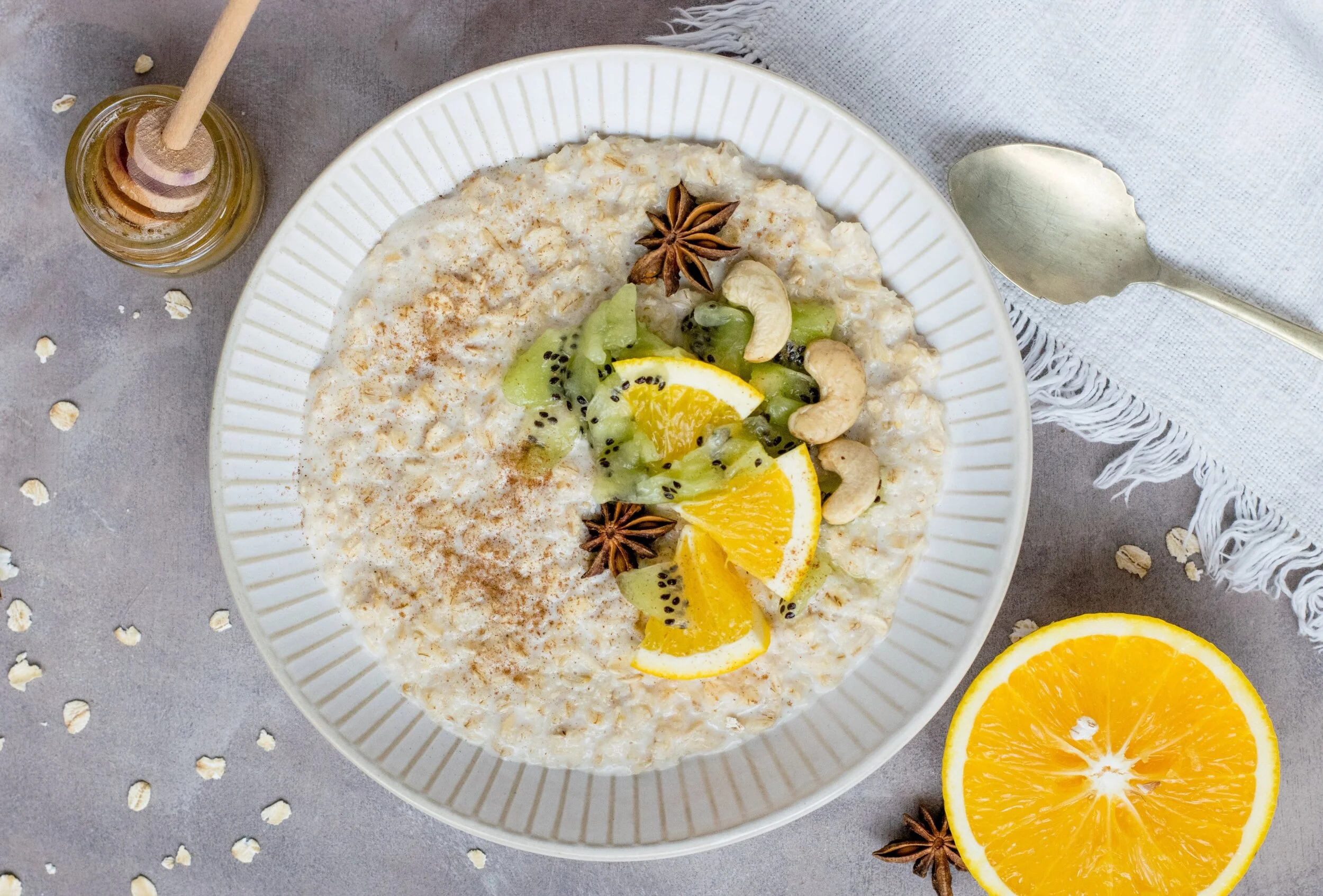
Photo by Monika Grabkowska on Unsplash
In short: Overnight oats are oats soaked in milk or yoghurt in the fridge overnight, so breakfast is ready the moment you wake up. I love them because they take two minutes to prepare while dinner is cooking, they keep you going all morning, and they’re endlessly adaptable. Add some protein and a little fruit and nuts, and you have a calm, filling start to the day. My simple base recipe and my autumn pear and walnut version are below.
It’s a weekday morning. You meant to have a proper breakfast, but the minutes run away from you, and you leave the house with a coffee in your hand and nothing in your stomach. By eleven you’re starving and slightly grumpy, and the first thing you find is a pastry or a handful of something sweet from the jar. Then lunch comes late, and the whole day feels a little off balance.
That rushed morning often shows up again later as the afternoon slump, which I wrote about in The afternoon energy dip in autumn. Not enough time in the morning for breakfast? That’s probably one of the best reasons to try overnight oats. They’re one of the simplest habits I know for starting the day well, and I still love them after all these years.
Why do I love overnight oats so much?
Because you can prepare them while you’re cooking dinner. You’re already in the kitchen, the pans are on, and while the dinner is cooking you bring out a jar, some oats, some milk and whatever fruit you have, and let your creativity take over. In a couple of minutes, tomorrow’s breakfast is ready. You put it in the fridge and you’re good to go the next day.
I usually make mine with hazelnut milk, which is my favourite, and depending on my mood and the fruit in the bowl, I top them with banana, blueberries and some nuts and seeds. In autumn I switch to pears, apples and walnuts. No two jars are quite the same, and that’s part of the pleasure.
And there’s something lovely about it that goes beyond convenience. Preparing your breakfast the evening before is a small act of kindness towards the person you’ll be tomorrow morning. You’re looking after her before she even wakes up.
What are overnight oats, exactly?
They’re oats that soak slowly in milk, yoghurt or both, in the fridge, overnight. You don’t cook them at all. During the night the oats drink up the liquid and soften, and in the morning you have something creamy, a little like a cold porridge or a Bircher muesli. In fact, Bircher muesli, the Swiss classic, is a close cousin.
Rolled oats work best. They soften beautifully and keep a little texture. Quick oats become very soft, almost mushy, and the big, chewy steel-cut oats stay too hard without cooking.
Are overnight oats healthy?
I’d rather not talk about foods as healthy or unhealthy. What I can tell you is why oats are such a good friend in the morning.
They’re rich in fibre. Oats contain a special kind of soluble fibre that turns soft and gel-like when it meets liquid. You can see it in your jar in the morning: that creamy texture is partly the fibre. In your body, it slows down digestion a little, so the energy from your breakfast arrives gently instead of all at once. And it’s lovely food for the bacteria in your gut. I wrote about that in how your gut and brain communicate.
They give you steady energy. Oats are carbs, and carbs are your body’s favourite fuel, for your brain as much as your muscles. Carbs aren’t the enemy, whatever you may have read. The trick is to eat them with friends: some protein, some healthy fats and some fibre, so that they keep you going for longer. I explained why your body needs enough fuel in Why you need more food, not less.
They’re a lovely base for other good things. On their own, oats are a fairly simple food. What makes a jar of overnight oats a really nourishing breakfast is what you put with them: yoghurt or kefir, nuts, seeds, fruit, a spoonful of nut butter. That’s where most of the protein, the healthy fats and the colour come from.
My basic overnight oats
This is the base I always come back to. It makes one generous breakfast. Use a jar with a lid, a bowl with a plate on top, or any container you have.
Ingredients
45 g (½ cup) rolled oats
120 ml (½ cup) milk of your choice: cow’s milk, or hazelnut, almond, oat or soya
60 g (¼ cup) plain yoghurt, kefir or skyr
1 tablespoon chia seeds or ground flaxseed (optional, for a thicker texture)
a pinch of cinnamon
a few drops of vanilla extract (optional)
Method
Put the oats, milk, yoghurt, seeds and cinnamon in your jar.
Stir well, making sure all the oats are under the liquid. If you’re using chia seeds, give it another stir after a few minutes so they don’t clump.
Close the lid and put it in the fridge overnight.
In the morning, give it a stir. If it’s too thick for you, add a splash of milk. Add your toppings and enjoy.
Overnight oats keep well in the fridge for a couple of days, so you can make two at once. I’d add fresh fruit and nuts on the morning you eat them, so they stay crunchy.
My autumn version: pear, walnut and cinnamon
When the pears are ripe and the walnuts have fallen, this is the jar I make. It tastes like a warm crumble, without any cooking. If you love cooking with what’s in season, you’ll find more autumn ideas in Eating with the seasons.
Ingredients
the basic overnight oats above
1 ripe pear
15 g (2 tablespoons) walnuts, roughly chopped
an extra pinch of cinnamon and a little grated nutmeg or ground ginger
1 teaspoon honey or maple syrup (optional)
Method
Grate half of the pear, skin on, and stir it into the oats the evening before. It sweetens the jar naturally as it soaks.
In the morning, slice or dice the other half of the pear over the top.
Scatter over the walnuts, add the spices and a drizzle of honey if you like.
The skin of the pear is full of fibre and colour, so I always leave it on. If you prefer apples, they work just as well. And on a cold morning, you can warm the jar gently in a pan for a minute or two. Overnight oats don’t have to be eaten cold.
What else can I put in my overnight oats?
Almost anything. Here are a few combinations to play with through the year.
Summer: banana, blueberries, a few raspberries and some sunflower seeds.
Apple pie: grated apple, raisins, cinnamon and chopped hazelnuts.
Winter: a spoonful of chestnut purée stirred in, with a few dried figs.
Cocoa: a teaspoon of cocoa powder in the base, sliced banana and a spoonful of nut butter on top.
Spring: stewed rhubarb and a few toasted almonds.
You’ll find more ideas for simple, everyday meals on my recipes page.
What helps your overnight oats keep you going all morning?
When I look at someone’s breakfast in my coaching, I’m not looking for perfection. I’m looking at whether it will carry them comfortably until lunch. Here’s what makes the difference.
1. Add some protein
This is the one I always start with. Oats alone have some protein, but not much. Yoghurt, kefir or skyr in the base, a spoonful of nut butter, nuts and seeds on top: they all help you feel satisfied for longer. If you’re over fifty, protein at breakfast matters even more, because your muscles need it spread across the day.
2. Add healthy fats
Walnuts, hazelnuts, almonds, chia seeds, ground flaxseed. They add crunch and flavour, and they slow digestion down a little more, so your energy lasts.
3. Let fruit do the sweetening
Grated apple or pear, mashed banana, a few raisins or dates. Fruit soaked overnight sweetens the whole jar. If you like a little honey or maple syrup, have it, and see if you enjoy it with a little less over time. A breakfast that keeps you going is also one of the gentlest ways I know to quieten sugar cravings later in the day.
4. Make it the night before, every night
The magic is in the habit. Tie it to something you already do, like cooking dinner or clearing the table, and it soon becomes automatic.
What doesn’t help?
Plain oats with water and nothing else. It won’t keep you going very long. Give your oats some company.
Ready-made flavoured pots full of sugar. They’re fine now and then, but the homemade jar is cheaper, simpler and you know what’s in it.
A huge mountain of fibre on day one. If you’re not used to oats and seeds, start with a smaller jar and drink well. Your gut will thank you.
Try this for one week
For seven evenings, while your dinner is cooking, make tomorrow’s overnight oats. Change the fruit and nuts each time, and include at least one spoonful of yoghurt, kefir or nut butter.
Each day at eleven o’clock, notice how you feel. Hungry? Settled? Tired? Write one word in a little notebook.
At the end of the week, read your words. Many people find their late morning is calmer, and that lunch feels less urgent. And you’ll know which combination you love most.
Frequently asked questions
Do you eat overnight oats cold?
Usually, yes, straight from the fridge, and they’re lovely that way. But you can warm them gently in a pan for a minute or two on a cold morning.
How long do overnight oats keep in the fridge?
A couple of days, in a closed jar. Add fresh fruit and nuts on the morning you eat them so they stay crisp.
Can I make overnight oats without dairy?
Yes. Use a plant milk you like and a plant-based yoghurt. I often use hazelnut milk. Add nuts, seeds or nut butter for protein, as plant milks can be quite light.
When should I talk to my doctor?
If you have coeliac disease or are sensitive to gluten, ask your doctor or dietitian whether oats are right for you; choose oats labelled gluten-free if they are. And if oats or extra fibre leave you very bloated or uncomfortable, or you have diabetes and are changing your breakfast, talk to your doctor too.
Would you like some help?
Breakfast is often the first thing I look at with someone, because a good morning makes the whole day easier. I run group programmes in nutrition and health, such as Six Tuesdays in Montignac, where we work on simple, real meals that fit your life. If you’d like to know when the next group opens, write to me at hello@catherinepolet.coach.
Not nearby? I coach one to one online too. Book a free 20-minute call, tell me what your mornings look like, and we’ll find a breakfast that really suits you.
About Catherine
I’m Catherine Polet, a holistic nutrition health coach, yoga and autogenic training teacher for more than 30 years, author and speaker. I help people find a way of eating and living that suits their own body, online in English, French, Spanish and German, and in person in Southwest France.

