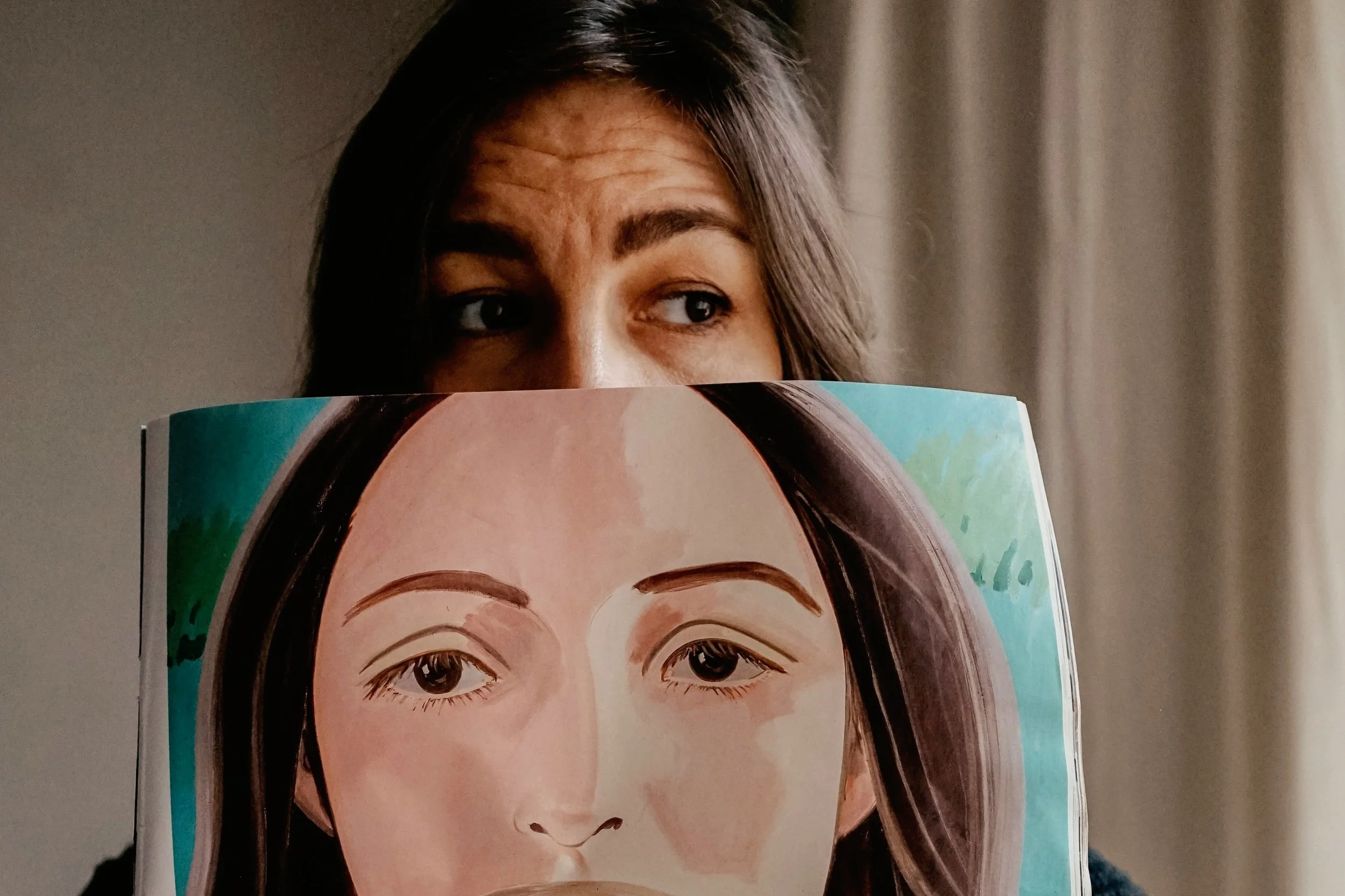
Photo by Toa Heftiba on Unsplash
In short: Negative self-talk is the harsh running commentary in your head: not good enough, not clever enough, not slim enough. You can’t switch it off by force, but you can learn to notice it, question it and answer it the way you would answer a friend. Change a few words, “I should” into “I choose to” or “what if”, and the whole tone of your day changes with them.
You send an email and spot the typo a second too late. “How stupid can you be?” You catch your reflection in a shop window. “Look at you.” You say something clumsy at dinner, and at bedtime you’re still replaying it, word for word, while everyone else at the table forgot it before dessert.
Now imagine saying those same sentences, out loud, to a friend. You wouldn’t. You wouldn’t even think them. And yet most of us speak to ourselves like this all day long, so often that we no longer hear it.
In this article I’d like to help you hear that voice, understand where it comes from, and learn how to answer it.
What is negative self-talk?
It’s the harsh, critical conversation you have with yourself. It doesn’t always shout. Often it’s a quiet, steady drip. It tends to take a few familiar shapes:
Self-criticism. You judge yourself harshly and look only at your flaws. One forgotten appointment becomes “I’m hopeless”.
Expecting the worst. Your manager asks for a word, and before you’ve reached her door you’ve already lost your job.
Making yourself small. Someone praises your work and you answer “oh, it was nothing”, and you believe it.
Taking it all on yourself. A friend is quiet at lunch, so it must be something you said. The picnic is rained off, and somehow that’s your fault too.
Do you recognise one or two of these? Simply being able to name them is a first step. A thought you can name is a thought you can look at, instead of a truth you have to swallow.
Where does the inner critic come from?
Very often from the past. A teacher’s remark, a parent who was hard to please, a rejection, a failure that hurt. Experiences like these can leave marks, and with them a set of beliefs about who we are. Years later, the voice in your head is still repeating a sentence someone else said first.
Those experiences happened, but they don’t define you. A past failure isn’t proof that you are a failure. It’s something that happened once, and something you learnt from. Looking at it that way doesn’t rewrite your history. It changes what you carry forward from it.
Why does it hold you back?
Because it feeds itself. The more you criticise yourself, the worse you feel, and the worse you feel, the more the critic finds to say. You stop trying new things, because you’ve already decided how they’ll end. You put off the phone call, the application, the first walk in your trainers.
Your body listens too. A day spent under constant criticism, even your own, is a tense day: tight shoulders, a knot in the stomach, a head that aches by the evening, a night that doesn’t rest you. I describe more of these quieter signals in my article on the hidden signs of stress.
The circle turns the other way as well. The more kindly you speak to yourself, the better you feel, and the easier the next kind word becomes. That’s why it’s worth starting small, today.
How do you answer the inner critic?
1. Notice it
You can’t change what you don’t hear. For a few days, simply listen in. When does the voice get loud? In front of the mirror, after a meeting, when you’re tired or hungry? Observe it without judging yourself for it. A few quiet minutes of mindful breathing each day make it much easier to catch your thoughts as they pass.
2. Question it
When you catch a harsh thought, ask it two things. “Is this really true?” And: “What’s the evidence?” More often than not, there isn’t any. “I never finish anything” doesn’t survive a look at everything you’ve finished this week.
3. Reframe it
Then put a kinder, truer sentence in its place. “I’ll never be good enough” can become “I have strengths and qualities of my own, and I bring them with me”. “I’m not good enough” can become “I’m capable, and I’m learning”. It may feel awkward the first few times. Keep going. With practice, the new sentence starts to sound like you. I wrote more about this in Mind your thoughts, change your life.
4. Speak to yourself as you would to a friend
If a friend rang you in tears because she’d made a mistake at work, what would you say? Say that to yourself. Everyone gets things wrong and has setbacks, and those are the very moments when gentleness helps most. This is what self-compassion means in practice.
5. See yourself as someone who is still growing
“I can’t do this” is a closed door. “I can’t do this yet” leaves it open. When you believe you can improve through effort and learning, a challenge becomes a chance to grow instead of one more reason to criticise yourself.
6. Choose what you let in
Spend time with people who encourage you, and less with those who leave you feeling smaller. The same goes for what you read, watch and scroll through. If something leaves you comparing and criticising every time, you’re allowed to switch it off.
What about all the “shoulds”?
There’s a kind of negative self-talk that doesn’t sound unkind at all. It hides in small words: should, have to, must, need to. “I should exercise more.” “I have to finish this tonight.” “I must go to that meeting.” Each one puts a little weight on your shoulders, and guilt follows close behind when you don’t obey.
Try changing the words.
From “I should” to “I choose to”. “I should exercise more” becomes “I choose to look after my health by moving regularly”. The action is the same. The feeling is completely different, because it’s yours.
From the threat to the benefit. “I have to finish this by tomorrow or I’ll be in trouble” becomes “when I finish this by tomorrow, I’ll feel proud that I kept my word”.
From obligation to reason. “I must attend this meeting” becomes “I’m going to this meeting because I want to know what’s happening and have my say”.
You nearly always have a choice. Reminding yourself of that, in your own words, gives you back the feeling that you’re the one steering.
How can “What if?” help?
This question opens a window. Instead of giving yourself an order, you offer yourself a possibility.
“I should go to the gym today” becomes “What if I went today and came home feeling wonderful?”
“I have to finish this project” becomes “What if I finished it by tomorrow and was truly pleased with my work?”
“I need to lose weight” becomes “What if I nourished my body with good food and movement, and felt confident and full of energy in it?”
Notice how that last one feels. No deprivation, no guilt for not being perfect. Just curiosity. That shift matters enormously in the way we eat, and I come back to it in my article on building a kinder relationship with your body and food.
Try this today
Pick one sentence your inner critic says often, and write it down exactly as you hear it.
Underneath, ask: “Is this really true?” Write down what speaks against it.
Write the sentence you’d say to a friend in the same situation. Keep it somewhere you’ll see it.
For the rest of the day, each time you hear yourself say “I should”, try it again with “I choose to” or “What if”.
Changing the way you think takes time. These patterns have been with you for years, and they won’t leave in a week. Be patient. Every time you catch one harsh thought and answer it kindly, you’re practising, and that counts. Answering the critic is one half of the story. The other half is building a warm relationship with yourself, and I write about that in The power of self-love.
Frequently asked questions
Is negative self-talk the same as being realistic about myself?
No. Being realistic means seeing what went well and what did not, and deciding what to do next. Negative self-talk only sees what went wrong, turns it into a verdict on you as a person, and offers no way forward.
Do positive affirmations really work?
They work when you can believe them. A sentence that feels false tends to bounce off. Choose words that are kind and true, such as “I am learning” or “I did my best with what I knew”, and repeat them when the critic starts.
How long does it take to change the way I talk to myself?
It is a habit, and habits change with practice, not overnight. Most people first notice that they catch the critic sooner. Later the harsh sentences come less often and lose some of their sting. Be patient with yourself on the way.
Why is my inner critic louder in the evening or at night?
When you are tired, hungry or alone with your thoughts, there is less to distract you and less energy to answer back. A proper meal, a calm end to the day and enough sleep make the voice quieter than any argument will.
When should I talk to my doctor?
Talk to your doctor if the harsh thoughts are there most of the day, if they keep you from sleeping, eating or working, if you feel low or anxious for weeks, or if you have thoughts of harming yourself. In that last case, ask for help straight away. A coach does not replace medical or psychological care.
Would you like some help?
The way you talk to yourself about food, your body and your habits is one of the things we work on in my group programmes in nutrition and health, such as Six Tuesdays in Montignac. If you’d like to hear when the next group opens, write to me at hello@catherinepolet.coach.
Would you rather work one to one? I also coach online. Book a free 20-minute call, and tell me what your inner critic says most often. We’ll look together for a kinder answer.
About Catherine
I’m Catherine Polet, a holistic nutrition health coach, yoga and autogenic training teacher for more than 30 years, author and speaker. I help people find a way of eating and living that suits their own body, online in English, French, Spanish and German, and in person in Southwest France.