

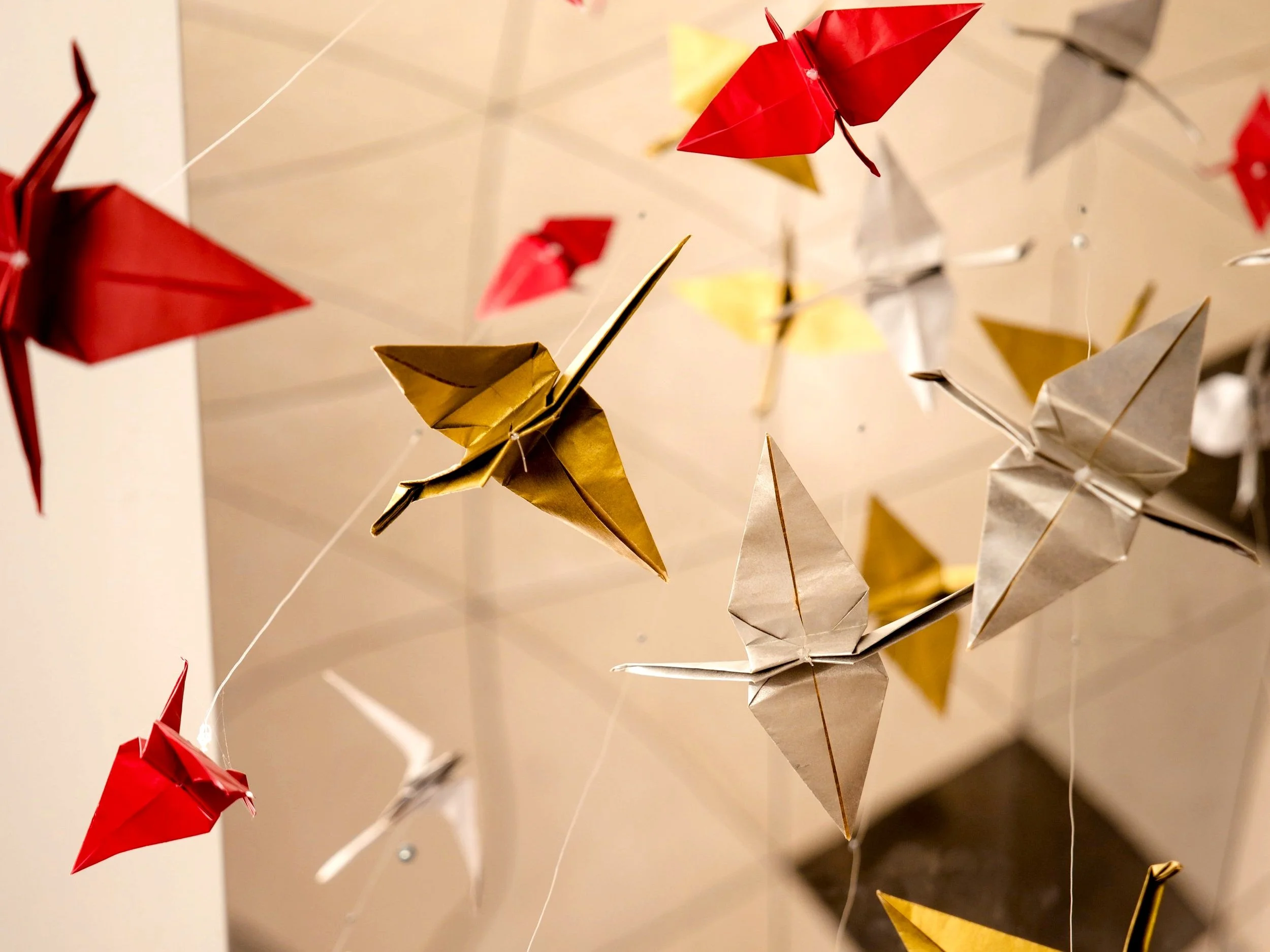
Photo by Jason Leung on Unsplash
In short: Senbazuru is the Japanese tradition of folding one thousand paper cranes and threading them together on strings. A legend says that whoever folds a thousand cranes will have a wish granted, which is why they are given to wish someone health, happiness and a long life. You don’t need a thousand to feel the benefit, though: folding even one crane, slowly and with attention, is a calming, mindful pause, and all you need is a square of paper.
It’s a dark afternoon in December. The list in your head is long: presents, cards, food, who sleeps where. You sit down for five minutes and, before you know it, your phone is in your hand and the five minutes have gone, without any rest in them at all.
Now imagine the same five minutes with a square of paper in front of you instead. You fold it in half, corner to corner. You run your nail along the crease. You turn it over and fold again. Your hands are busy, your eyes have one small thing to look at, and your thoughts, for once, slow down to the speed of your fingers. That is what paper folding can give you, and it is why origami and the thousand cranes have a place here, among articles on food and health.
What is origami?
Origami (折り紙, from oru, to fold, and kami, paper) is the Japanese name for the art of paper folding. The only thing you need is a piece of paper, which makes it one of the most accessible arts there is. No brushes, no tools, no special table. A sheet of paper and your two hands.
From that one sheet, traditional origami can produce all kinds of models: animals, flowers, people, planes, boats, cars, boxes, masks. There are books and websites in abundance to show you how to fold each of them, and the only real limit is your imagination.
The most famous figure of all is the crane. The first known book of instructions dates from 1797, and its title says it all: “How to fold a thousand cranes”.
What is a senbazuru?
Senbazuru (千羽鶴) means one thousand cranes. It is a set of a thousand origami cranes (tsuru is the Japanese word for crane) held together on strings.
An ancient Japanese legend promises that anyone who folds a thousand origami cranes will have their wish granted by a crane: a long life, for example, or healing from an illness or an injury. The Japanese crane is one of the mystical creatures, along with the dragon and the turtle, and it is said to live for a thousand years.
Why are a thousand cranes given as a gift?
Because of the legend, a senbazuru is a popular gift for close friends and family. Traditionally, a thousand paper cranes are given as a wedding gift by the father, who wishes the couple a thousand years of happiness and prosperity. They can also be given when a baby arrives, to wish the child a long life and much luck. And hanging a senbazuru in your home is considered a powerful symbol of good luck and goodwill.
A thousand cranes can’t be bought in a hurry on the way to the party. Every one of them has passed through somebody’s hands, and the person who receives them knows it.
Why is folding paper so calming?
Spending time making origami is like a moment of meditation, of mindfulness. You can’t fold a crane while you answer a message or think about tomorrow’s meeting. If your attention wanders, the corners stop meeting and the paper tells you so straight away. So you come back to it, gently, again and again. That coming back is exactly what we practise in meditation, only here you have something to hold.
This is why paper folding suits people who say they “can’t meditate”. If sitting still with your eyes closed makes you restless, give your hands a job. The repetition does the rest: the same folds, in the same order, a little smoother each time. Your breathing slows down without you having to think about it. If you’d like to add the breath on purpose, you’ll find simple ways to do it in my gentle introduction to coming back to your breath, and I’ve answered the most common questions in 18 FAQs on mindfulness.
There’s also a quiet pleasure in making something with your hands at the end of a day spent in your head or in front of a screen. A small paper bird on the table is proof that you stopped for a moment. If screens are taking more of your evenings than you’d like, you might also enjoy what I wrote about a digital detox.
What do you need to get started?
Paper
You can use almost any paper. “Origami paper” is thin and strong and folds very well. It is usually white on one side and coloured on the other, and it comes cut into squares, most often 15 cm. It’s usually a solid colour, but printed designs exist too: the larger sheets often have traditional Japanese or flower patterns, reminiscent of kimono fabric.
For a senbazuru, the size of the paper doesn’t matter, but smaller sheets make smaller and lighter chains of cranes. The most popular size is 7.5 cm by 7.5 cm. In Japan, senbazuru sets are widely sold: a thousand sheets of paper or a few more (in case of mistakes), string, and beads to place at the end of each chain so that the cranes don’t slide off.
Or simply what you have at home
You don’t need to buy anything. Some people cut their own squares from whatever they have: magazines, newspapers, notebooks, printer paper. If there’s a pile of old magazines waiting to go out, you can turn a few pages into cranes first. You recycle, you spend nothing, and you do something for the planet at the same time.
Clear instructions
The crane has quite a few steps, and it’s much easier to follow hands than drawings. The British Origami Society has a video that shows you, step by step, how to make the crane.
How are the thousand cranes put together?
Usually the cranes are assembled on 25 strings of 40 cranes each. You thread a bead or tie a knot at the bottom of each string, pass the string up through the cranes one after the other, and then tie the strings together at the top so that they hang like a curtain of colour.
A thousand is a long project. That is part of its meaning: a few cranes in the evening, week after week, with the person you’re folding for in your thoughts. But please don’t let the number put you off. You can fold one crane today, or a single string for a window.
Try this: ten quiet minutes with a square of paper
Clear a small space. A corner of the kitchen table is enough. Put your phone in another room, unless you need it for the instructions.
Cut your square. Take a page from a magazine, fold one corner across to the opposite edge and cut off the strip that’s left over.
Fold slowly. Speed isn’t the point. Line the edges up carefully and press each crease flat with your nail. Notice the sound of the paper and how it feels under your fingers.
Be kind to your first crane. It will probably be a little crooked. Keep it anyway. The second one is always easier, and the tenth almost folds itself.
Stop while it’s still a pleasure. One crane is enough for today. Put it where you’ll see it tomorrow morning.
A good moment to begin: the winter holidays
Why not take advantage of the winter holidays to get started? December is a busy month, and folding is a great way to take a real break in the middle of it. If the season tends to overwhelm you, I’ve gathered a few more ideas in my last-minute tips for a calm Christmas and in things to do when it’s cold outside.
If you have children (not too young), folding together gives them a moment away from their screens, and it’s quality time with them. Everyone at the table with a pile of paper squares, a pot of tea, and nobody in a hurry.
And even if you already have all your Christmas decorations, think about making something yourself, for the house or as a present. A few cranes on a string for the tree, one tucked into a card, a little chain for a friend who is going through a hard time. Giving something you made yourself is priceless. If you like the idea of handmade gifts, you could also try making your own candles.
Frequently asked questions
Do I need special origami paper?
No. Origami paper is pleasant to work with because it is thin, strong and folds cleanly, but any paper cut into a neat square will do. Pages from old magazines, newspapers, notebooks or printer paper all work, and reusing them is kinder to the planet.
Is origami really a form of mindfulness?
It can be. Folding asks for your full attention on something small and simple: the edge, the corner, the crease. While your hands are busy, your thoughts have less room to race. It is not a replacement for meditation, but for many people it is an easier way in.
Do I have to fold all one thousand cranes?
Not at all. The thousand cranes of the senbazuru are a beautiful tradition, and some people love the long project. But one crane folded slowly, with your whole attention, already gives you the quiet moment. Start with one and see where it takes you.
Can children fold paper cranes?
Yes, if they are not too young. The crane has quite a few steps, so smaller children may enjoy starting with a simpler model such as a boat or a box. Folding together is a lovely way to spend time away from screens.
What can I do with the cranes I fold?
Thread them on a string and hang them at home, add one to a parcel or a card, decorate the table or the Christmas tree, or give a string of them to someone you are thinking of. In Japan, a senbazuru is a traditional gift to wish someone health, happiness and a long life.
Would you like some help?
Finding small, quiet pauses in a full day, and learning to protect them, is one of the things we work on in my group programmes in nutrition and health, such as Six Tuesdays in Montignac. We look at what’s on your plate, and just as much at how you rest, breathe and recharge. If you’d like to hear when the next group opens, write to me at hello@catherinepolet.coach.
Would you rather work one to one? I also coach online. Book a free 20-minute call, and we’ll talk about where your days could use a little more calm. You’re very welcome to bring your first crane along.
About Catherine
I’m Catherine Polet, a holistic nutrition health coach, yoga and autogenic training teacher for more than 30 years, author and speaker. I help people find a way of eating and living that suits their own body, online in English, French, Spanish and German, and in person in Southwest France.

